Insights
Leadership briefs, reports, and resources for higher education leaders working through questions of leadership, role design, decision making, and institutional effectiveness.
Conditions for Success: Understanding the Senior Faculty Affairs Officer’s Role in 2026
A leadership brief for provosts, SFAOs, and academic leadership teams examining how institutions can structure and support Faculty Affairs as a strategic leadership function.
The brief is based on interviews with four Senior Faculty Affairs Officers to understand how these roles are structured, what supports their effectiveness, and what tends to consume their time and attention. It examines authority, relationships with the Provost’s leadership team, faculty support and accountability, administrative workload, and protecting time for strategic work.
The brief includes:
Findings from interviews with four Senior Faculty Affairs Officers
Implications for developing the SFAO and the academic leadership system that surrounds them
A decision framework for provost’s offices examining the role
Ten strategic questions for provosts, SFAOs, and leadership teams
An anonymized appendix describing the four roles represented in the interviews
How Higher Ed Leaders Can Find Value in the Flawed Strategic Planning Genre
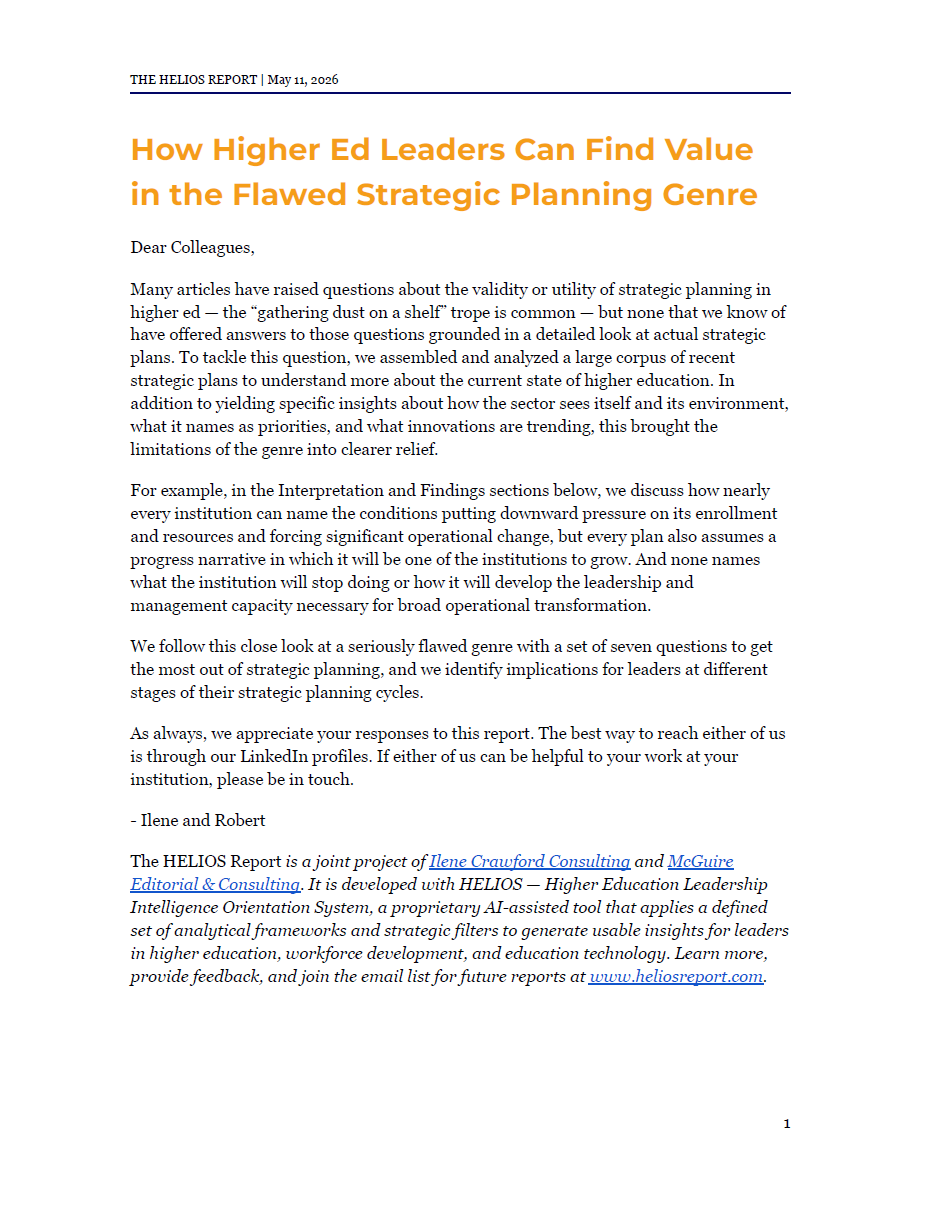
This HELIOS Report examines 45 strategic plans published by U.S. colleges and universities in 2025 and early 2026 to understand what institutions say about their priorities, pressures, and plans for change. The analysis finds a recurring gap between realistic diagnoses of sector conditions and the limited attention plans give to institutional tradeoffs, implementation, leadership capacity, and the work that must stop to make room for new priorities. The report argues that strategic planning remains useful when leaders recognize those limitations, and it outlines implications for a variety of institutional stakeholders and offers discussion questions to help get more value from the process.
Making Sense of AI in Higher Ed: A Leadership Briefing for an Unsettled Field
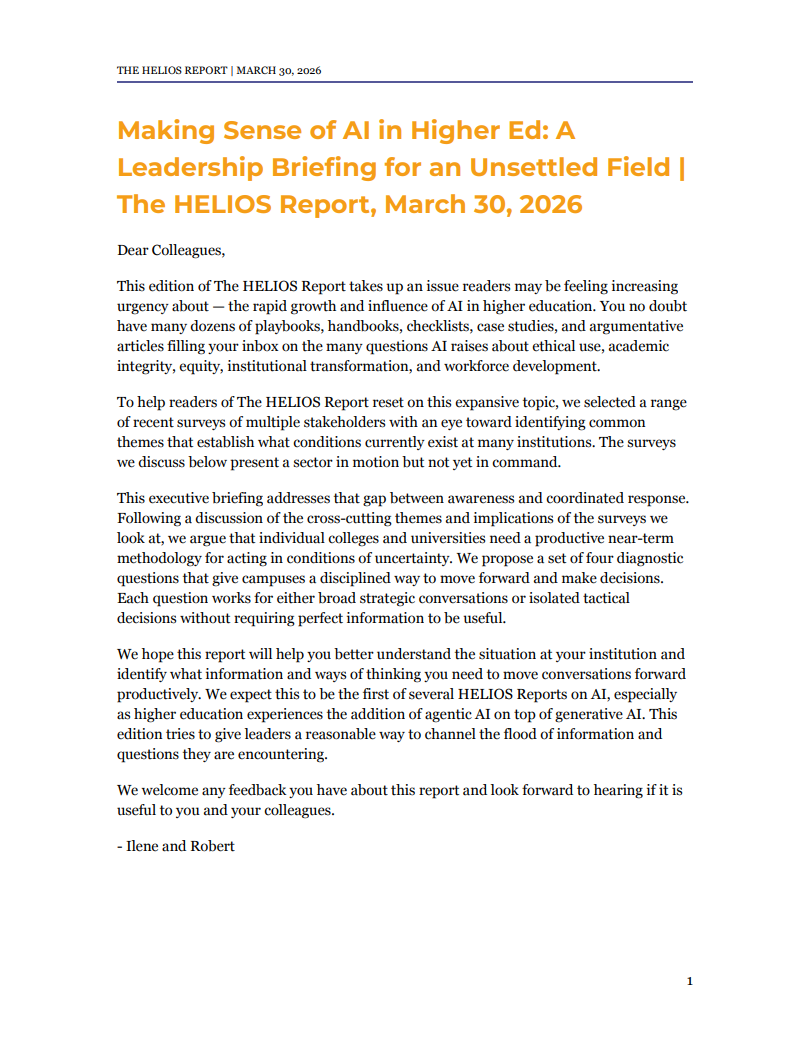
Drawing on recent surveys of presidents, faculty, staff, students, and prospective students, this HELIOS Report examines how generative AI is reshaping higher education faster than institutions are developing shared norms, policies, and decision-making practices. It considers the implications for teaching and learning, academic leadership, operations, student support, institutional risk, and leadership development. It also offers a framework leaders can use to evaluate AI decisions at any level of the institution, focusing on human judgment, processing speed, privacy and dignity, and alignment with institutional mission and the institution’s understanding of learning.
Holding Academic Integrity and Performance Accountability in the Same Conversation: Implications for Higher Ed Leaders

This HELIOS Report examines the growing pressure on colleges and universities to evaluate academic programs explicitly in terms of cost, demand, student outcomes, workforce relevance, and public definitions of value. Drawing on recent policy changes and new frameworks from influential nonprofits in the higher education sector, it argues that academic leaders are increasingly being asked to manage programs as a portfolio of distinct investments rather than as a cohesive curriculum.
The report considers what this shift means for presidents, provosts, deans, faculty, finance leaders, advisors, and others across the institution. It also offers six questions to help leaders make program-level decisions while preserving academic integrity.